
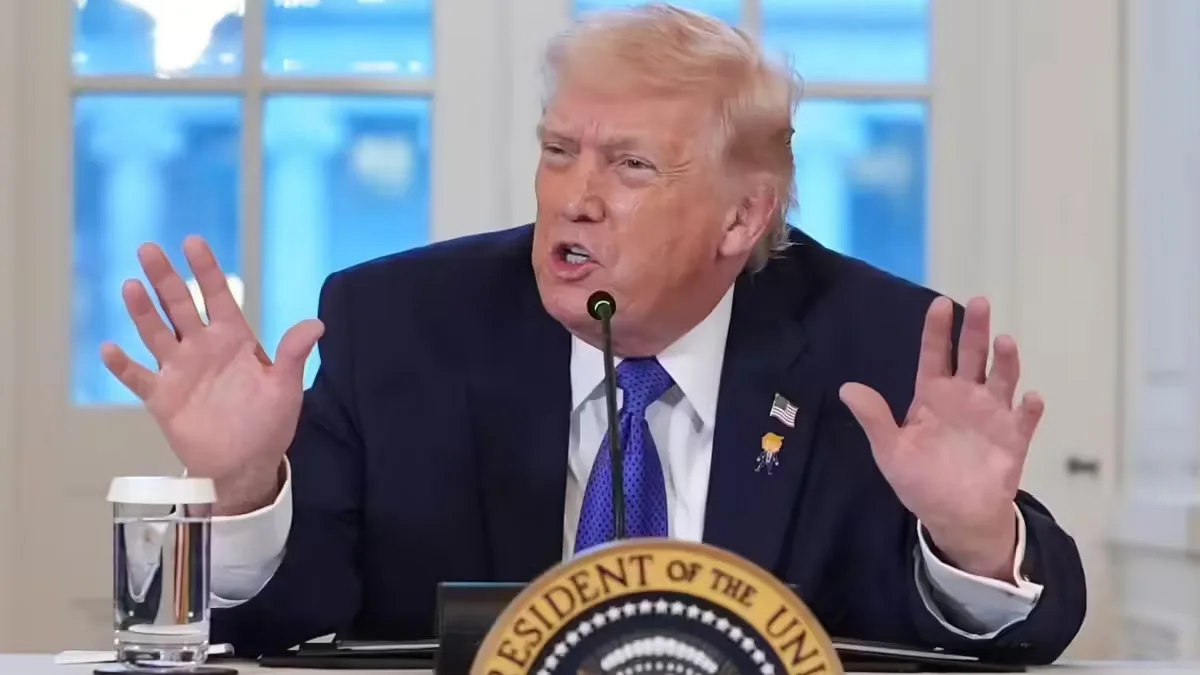
In escalating rhetoric that has rattled both allies and Arctic security experts, U.S. President Donald Trump has reiterated his dramatic claim that the United States should acquire control of Greenland – by agreement if possible, or “the hard way” if not. Trump says the move is necessary to protect U.S. interests against rising powers like Russia and China, and has framed the struggle for Greenland as central to America’s Arctic geopolitical strategy.
In a now widely quoted statement, U.S. President Donald Trump said, “I want to do it the easy way, but if we don’t do it the easy way, we’ll do it the hard way.” He insisted that the U.S. “needs Greenland,” arguing that control – not just access – is essential for defense and deterrence against growing rival military forces in the Arctic seas.
Why U.S. President Donald Trump Said-“Greenland Matters to U.S.”
Trump’s public defense of his position – and his threat of the so-called “hard way” – can be traced to three main arguments:
Strategic National Security:
Greenland sits astride crucial air and sea routes between North America, Europe, and the Arctic. For decades, the U.S. has maintained a Cold War-era military base at Pituffik (formerly Thule). Still, U.S. President Donald Trump says that ownership – not just a military presence – is needed to truly defend the island and prevent rivals from gaining a foothold.
Countering Russia and China:
According to Trump, Arctic competition is not abstract: He has repeatedly pointed to Russian destroyers and Chinese naval activity near Greenland’s waters as evidence that great powers could one day seize the island if the U.S. hesitates. Trump’s message: If we don’t act, China or Russia will, and we won’t let either of them become “our neighbor.” Long-Term Geopolitics:
Beyond situational advantages, controlling Greenland—according to Trump—is considered crucial to ensuring American dominance in the High North, where melting ice is opening new shipping lanes and exposing vast mineral reserves. Experts say these developments are central to evolving Arctic geostrategic calculations, even if U.S. President Donald Trump publicly downplays the resource angle.
Allies’ Rebuke and Arctic Diplomacy
Trump’s uncompromising language has alarmed allied capitals. Danish Prime Minister Mette Frederiksen publicly warned that any US military action against any territory of the Danish realm would jeopardize NATO cooperation and destabilize the collective security framework.
Similarly, Greenlandic leaders and civil society groups have categorically rejected Trump’s proposals. The head of Greenland’s largest labor union stated, “We are not for sale,” dismissing the president’s assertion that Greenland should be ceded for US security.
European allies, from France to Germany, issued joint statements emphasizing that decisions about Greenland’s future belong solely to Denmark and Greenland, not to outside powers—not even NATO partners.
Why the Arctic Matters
What makes Greenland such a contested geopolitical prize is not just its size—but its location and the resources hidden beneath its ice. Climate change has made the Arctic more accessible than at any other time in modern history, opening new shipping routes and revealing reserves of oil, gas, rare earth elements, and other critical minerals.
These resources are vital for everything from military hardware to renewable energy technologies, intensifying competition among global powers. As part of a broader Arctic geopolitical strategy, the U.S. views Greenland as a crucial link in a region where Russia has long held sway and where China has declared itself a “near-Arctic state.” The melting ice has transformed this once-remote frontier into a focal point of global strategic interest.
What happens next?
Diplomacy continues. Denmark has agreed to talks with U.S. officials aimed at de-escalating tensions and exploring cooperative security and economic arrangements. However, growing pressure for Greenland’s independence adds another layer of complexity: any change in sovereignty would require not only Danish approval but also the consent of the Greenlanders themselves.
U.S. President Donald Trump shows no signs of backing down, even as allies object. Whether his blunt talk about taking Greenland “the hard way” is a turning point in Arctic geopolitics—or a storm in a diplomatic teacup—remains to be seen. But what is already clear is that Greenland’s future is no longer merely a regional matter—it has become a stage for great power competition and a defining challenge for 21st-century security politics.
Also Read: Amazon Layoffs Lead New Wave of U.S. Job Cuts as WARN Notices Surge