
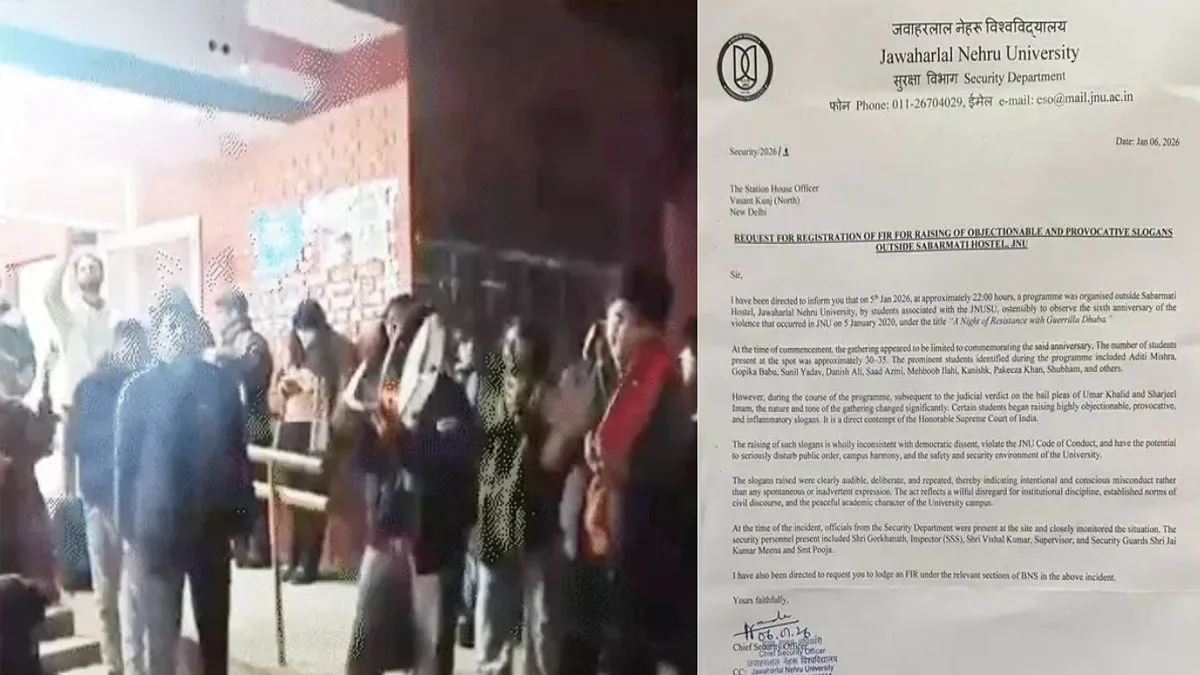
JNU Protests: Jawaharlal Nehru University (JNU) has once again made national headlines after allegedly provocative and offensive slogans were raised against Prime Minister Narendra Modi and Union Home Minister Amit Shah on its campus. Taking a strong stance, the JNU administration has condemned the incident and made it clear that the university cannot be allowed to become a “laboratory of hatred.” The administration has warned of strict disciplinary and legal action against those responsible.
The controversy erupted when videos circulated on social media showing a group of students chanting slogans late at night near a hostel on campus. The incident reportedly followed a recent Supreme Court ruling related to the bail applications of former student activists, which had prompted protests from some student groups.
JNU Protests: JNU Administration’s Zero-Tolerance Message
In an official statement, the JNU administration termed the slogans provocative, inflammatory, and completely unacceptable in an academic environment. Emphasizing the university’s role in fostering critical thinking and healthy debate, the administration stated that while democratic dissent is respected, abusive or hateful speech crosses a clear line.
The statement stressed that academic institutions are centers of learning and dialogue, not places for spreading hatred or animosity. “The university cannot be transformed into a laboratory of hatred,” the administration said, adding that such activities violate the JNU Code of Conduct and undermine the university’s academic spirit.
View this post on Instagram
JNU Protests: FIR Sought, Investigation Launched
Sources have confirmed that the university has written to the Delhi Police to register an FIR regarding the slogan-chanting incident. Simultaneously, an internal inquiry has been launched to identify those involved. CCTV footage, viral videos, and other available evidence are being examined to determine responsibility.
Officials have indicated that once the investigation is complete, strict disciplinary action will be taken against the students found guilty. This could include suspension, expulsion, or other penalties as per university rules. The administration also made it clear that no individual or group would be spared if the violations were proven.
Political Reactions Intensify Debate
The incident has sparked sharp political reactions. Leaders of the Bharatiya Janata Party (BJP) strongly criticized the slogans, calling them an insult to constitutional offices and demanding strict action to prevent similar incidents in the future. Some leaders accused a section of campus politics of repeatedly crossing the boundaries of freedom of expression.
Meanwhile, opposition parties defended the right to protest but urged restraint in language and conduct. They argued that dissent should be peaceful and respectful, and that personal abuse or hate speech weakens rather than strengthens democratic expression.
Freedom of Expression vs. Campus Discipline
The JNU slogan controversy has once again reignited the larger debate on freedom of expression in universities. Education experts say that campuses should remain spaces for debate, dissent, and ideological diversity. However, they also emphasize that freedom of expression comes with responsibility and must operate within constitutional and institutional limits.
According to academic observers, slogans deemed hateful or threatening can damage the campus environment and invite legal consequences, ultimately harming the academic atmosphere.
JNU’s Past and Present Investigations
JNU has a long history of student activism and political engagement, often attracting national attention. Past controversies over slogans and protests have repeatedly placed the university at the center of political and media debates. This latest incident adds to that legacy and highlights the ongoing challenge of balancing activism with academic discipline.
What Lies Ahead
As the investigation continues, all eyes are on the actions taken by the JNU administration and the response of law enforcement agencies. The case is likely to remain in the spotlight, not only as a campus issue but also as part of a larger conversation about democratic dissent, the limits of protest, and responsibility in academic institutions. For now, the administration’s message is clear: JNU, or any university, will not be allowed to become a platform for hatred, and those who violate this will face the strictest possible action.
Also Read: UIDAI Introduces ‘Aadhaar Vision 2032’: A Next-Gen Roadmap for India’s Digital Identity