
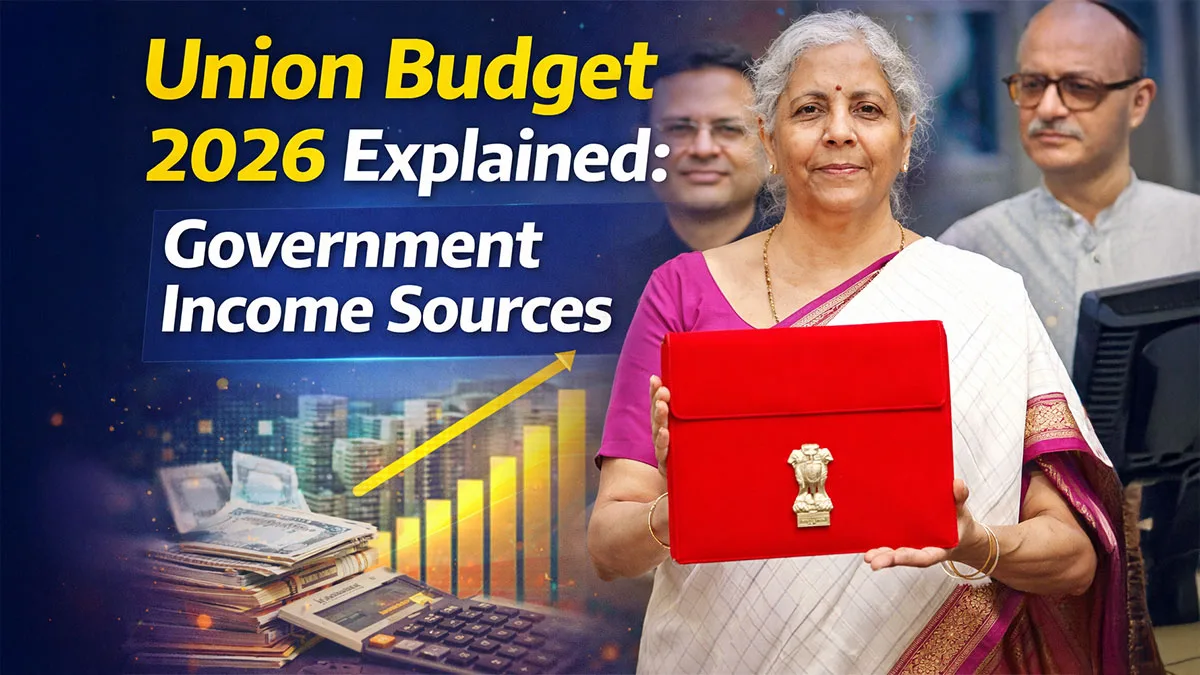
Union Budget 2026 Explained: Every year, the Government of India presents the Union Budget, which acts as a financial roadmap for the country. The Union Budget 2026 is not just a statement of expenses; it also explains how the government plans to raise funds to run the nation, support welfare schemes, and boost economic growth.
To meet its financial needs, the government collects money from multiple sources. These include tax revenue, non-tax revenue, borrowings, and capital receipts. Together, these sources help the government manage development, administration, and public welfare.
Union Budget 2026 Explained: The Biggest Source of Government Income
Tax revenue remains the largest contributor to government earnings under the Union Budget 2026. Taxes are broadly divided into direct taxes and indirect taxes.
Also Read: SSC Exam Calendar 2026–27 Released: Check Tentative Dates and Schedule
Direct Taxes
Direct taxes are imposed directly on individuals and businesses. These include:
- Income Tax paid by individuals
- Corporate Tax paid by companies
These taxes are based on income and profits, making them a crucial and stable source of revenue for the government.
Indirect Taxes
Indirect taxes are collected on goods and services rather than income. The most important among them is:
- Goods and Services Tax (GST)
Apart from GST, the government earns significantly from excise duties on products like petrol, diesel, and alcohol. Indirect taxes help maintain a steady cash flow and support large-scale government spending.
Through taxation, the government not only generates revenue but also tries to reduce economic inequality by ensuring higher earners contribute more.
Non-Tax Revenue: Income Beyond Taxes
Apart from taxes, the Union Budget 2026 also depends on non-tax revenue. This includes income earned from various government-owned services and assets.
Also Read: World-Class Elegance Meets Power: Motorola Unveils the All-New Motorola Signature
Major non-tax revenue sources are:
- Fees for public services
- Fines and penalties
- License and registration charges
- Dividends from public sector enterprises
Institutions like Indian Railways, India Post, public sector banks, and government-owned companies play a key role in generating this income.
Additionally, the government earns money by auctioning natural resources such as coal mines, minerals, and telecom spectrum. Although non-tax revenue is smaller compared to tax collections, it still plays an important role in balancing the budget.
Borrowings: Filling the Gap Between Income and Expenses
When government expenditure exceeds its income, borrowing becomes necessary. Under the Union Budget 2026, borrowings are used carefully to manage fiscal needs.
The government raises funds by:
- Issuing government bonds to banks, insurance companies, and the public
- Collecting money through small savings schemes
- Taking loans from international financial institutions and foreign governments
In some cases, the government also sells its stake in public sector companies, a process known as disinvestment, to generate additional funds.
Borrowing helps the government invest in infrastructure, healthcare, education, and long-term development projects, though it must be managed wisely to control fiscal deficit.
Union Minister for Finance and Corporate Affairs Smt. @nsitharaman chairs the meeting on Pre-Budget Consultation with States and Union Territories (with Legislature) for the forthcoming Union Budget 2026-27, in New Delhi, today.
Along with Union Minister for State for Finance… pic.twitter.com/fcTqVWhMkT
— Ministry of Finance (@FinMinIndia) January 10, 2026
The Union Budget 2026 reflects how the Government of India balances income and expenditure to ensure national growth and public welfare. By combining tax revenue, non-tax income, borrowings, and capital receipts, the government funds development projects and social schemes that shape the country’s future.
Understanding these income sources helps citizens better appreciate how the budget works and how government policies impact the economy.