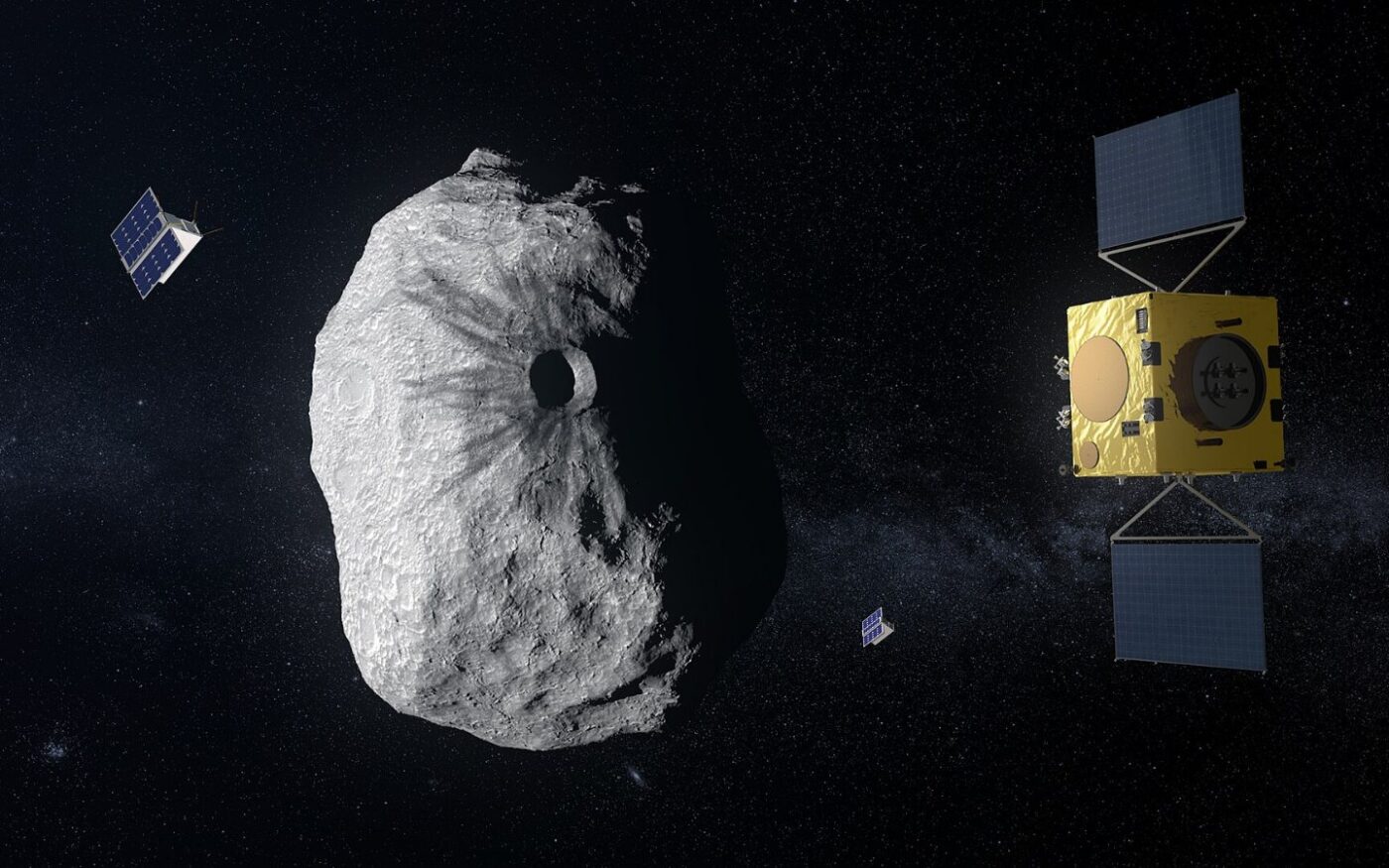
Europe’s planetary-defence probe Hera has, for the first time, seen its target as two separate objects. The European Space Agency (ESA) announced on October 27, 2026 that an image taken on the evening of October 18 from about 1,280 km away splits the Didymos system into the large asteroid Didymos and its small moonlet Dimorphos, the body NASA deliberately crashed a spacecraft into in 2022. The image marks the start of the closest look yet at the only celestial object whose orbit humans have measurably changed.
What happened
Hera’s monochromatic Asteroid Framing Camera captured the frame as the spacecraft closed in on the pair, which sits roughly 197 million km from Earth. In the picture, Dimorphos covers barely a single pixel, but it stands clearly apart from its larger companion. Until now, Didymos had appeared only as one point of light; ESA’s first-sighting image, released on October 7, exactly two years after launch, caught the system from about 236,500 km as a dot smaller than one pixel.
To make the approach possible, mission controllers fired Hera’s thrusters twice, a week apart, slowing the spacecraft to about 20 metres per second relative to the asteroids. That gentle speed lets the team creep in gradually and adjust the trajectory as they learn more about the system’s gravity and shape.
ESA quoted Hera scientist Michael Kueppers as saying, “With this image the smaller Dimorphos asteroid becomes visible for the first time.” Mission manager Ian Carnelli described it as the first time the team was “seeing through Hera’s own eyes the very double asteroid system” it had set out to study.
Background: from DART’s impact to Hera’s inspection
On September 26, 2022, NASA’s Double Asteroid Redirection Test (DART) spacecraft struck Dimorphos at about 6.1 km per second. The impact flung debris across some 10,000 km and shortened the moonlet’s orbit around Didymos by roughly 33 minutes, a far larger change than many pre-impact simulations had predicted. DART demonstrated that a “kinetic impactor” can nudge an asteroid, but it could not measure how much mass Dimorphos has, how its interior is built, or what the collision did to its surface.
That is Hera’s job. ESA launched the spacecraft on October 7, 2024, used a Mars flyby in March 2025 to bend its path toward the asteroids, and has said it expects to arrive in November 2026, about a month earlier than originally planned, according to an earlier ESA update.
Key facts
- Image date: October 18, 2026; released by ESA on October 27, 2026.
- Range: about 1,280 km from the asteroids; the system was about 197 million km from Earth.
- Dimorphos: about 151 m across, roughly the size of Egypt’s Great Pyramid.
- Didymos: about 780 m in diameter; the two orbit an average of 1.15 km apart.
- Approach speed: about 20 m/s relative to the asteroids after two braking burns.
- Next milestone: ESA plans to release detailed images of Dimorphos on November 25, 2026.
- Companions: two small CubeSats, Milani and Juventas, will be released for closer surveys, with the mission eventually ending in landing attempts.
What Hera will try to answer
Over the coming months, ESA describes the work ahead as a “crash site investigation.” The key questions include whether DART left a crater or reshaped Dimorphos entirely, what the moonlet is made of, how dense and how loosely bound it is, and why the deflection was so much larger than expected. Measuring Dimorphos’s mass precisely is central: combined with the known change in its orbit, it lets scientists calculate how much extra push came from debris thrown off by the impact, a factor that strongly affects how well a future impactor would work.
Perspective: why it matters
DART proved the principle; Hera is meant to turn it into engineering. If a dangerous asteroid is ever found on a collision course, mission planners will need to know how big an impactor to send and how early to launch it. That depends on how real asteroids, many of which may be loose piles of rubble rather than solid rock, respond to being hit. A single, carefully measured test case is worth a great deal more than models alone.
The mission is also a notable example of international division of labour: a NASA impact followed by a European inspection, with data that will be shared across the global planetary-defence community. For spacefaring nations still building their own planetary-defence capabilities, India among them, Hera’s results will offer a public benchmark of what it takes to characterise a threat in detail. The first frame is only a pixel-sized hint; the more consequential findings should start arriving with the close-up images promised for late November.
Sources
- ESA — First light: Hera resolves two asteroids instead of one
- ESA — Destination sighted: Hera’s first glimpse of Didymos
- ESA — Hera’s first view of the separate Didymos and Dimorphos asteroids (image)
- ESA — ESA’s Hera targets early arrival at Didymos asteroids
- ESA — Hera takes flight: Didymos, here we come